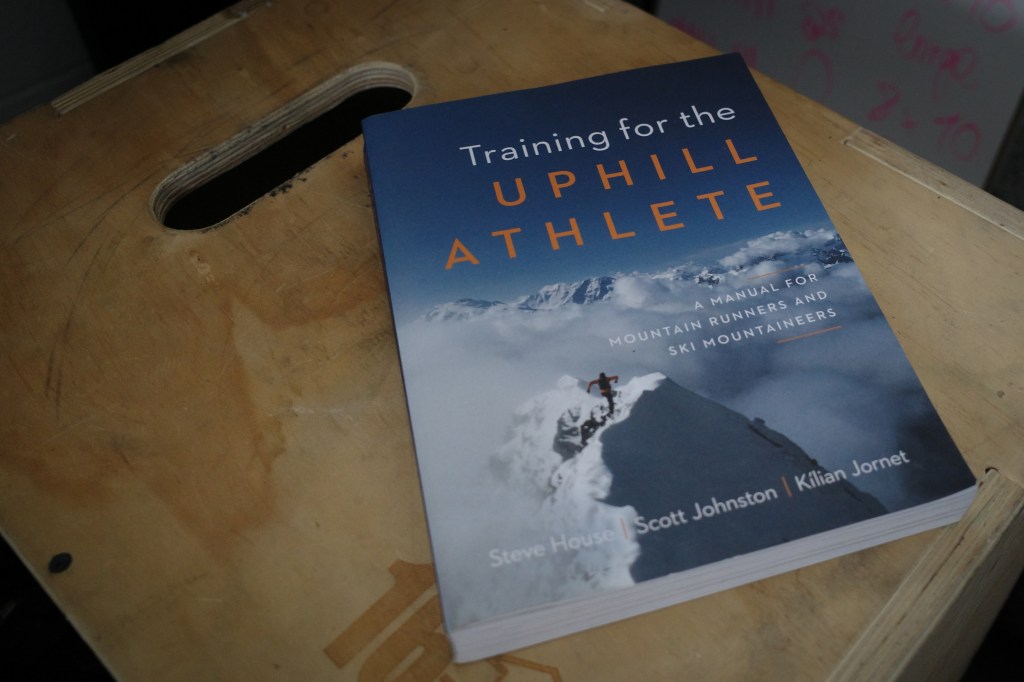
This series documents my training block for the Black Canyons 100K in February 14, 2026. After signing up for the race a couple of months ago, I quickly devoured all the content I could find from the previous editions produced by middle of the pack runners. Hearing from the pros is interesting for other purposes, but there isn’t that much I can learn from them when thinking about my own race execution.
I will be following a training plan that’s based on the principles outlined in Training for the Uphill Athlete. The methods outlined in the book have recently become fashionable because one of the authors, Scott Johnston, coached both the female and male winners of the UTMB. The training approach is simple. During the first half of the block, you do a lot of muscular endurance gym work (low weights with plenty of reps) supplemented with four days of easy running. Then, for the second half, you switch one or both muscular endurance sessions to hill sprints while keeping the rest of the structure pretty similar. It’s not the type of training that looks particularly impressive on Strava because you’re virtually never running fast relative to your fitness.
Even though it’s not my intention to spend a lot of time in this training log talking about training theory, it’s fun to note (especially given my dual interest) that Johnston has a quirky causal model of why certain types of training works, as he highlighted in episodes #121 and #122 of his podcast. In short, his main argument is that hard, short intervals do not improve performance in endurance events because they increase an athlete’s VO2 max, as is the prevalent theory. Instead, he argues that those types of intervals work (in so far as they do) because they target the muscles that will get fatigued in long endurance events.
It follows from this causal model that you can achieve the same benefit as you would from VO2 training by loading the relevant muscles in a more targeted manner. In practice, this means that, instead of doing a lot of fast sprinting, you do weight(ed) training that mimics the demands of the event you’re targeting. Typical workouts include box step ups or uphill hiking using a weighted vest. For reasons that apparently are not particularly well understood, doing high rep, low weight training is a particularly effective way to improve the fatigue resistance of muscles. The benefit of targeting the muscles directly as opposed to targeting them as a byproduct of VO2 max training is that the weighted workouts place less stress on the body as a whole, improving recovery. And recovery, as all endurance athletes know, is the key to consistent training.
Anyway, I promised not to focus too much on training theory. What am I going to be talking about, then? My plan is to discuss the experience of training for a challenging endurance event and the reflections that arise from that experience. At the end of the day, I don’t think that events, training plans and performance indicators have any intrinsic value: they are only there as scaffoldings to enable the deeply human experience of pushing myself relative to my own limits.
 totte.cc
Leave a comment